Meeting Challenges
Over the last 70 years the Hussars have had to deal with many types of enemy in a wide range of environments.
The Hussars have always adapted their tactics and training to enable them to respond effectively.
 Brodie Helmet.
The Brodie helmet is a steel combat helmet designed and patented in London in 1915 by John Leopold Brodie.
This is an example of the type of steel helmet that was worn by the 3rd Hussars whilst in the trenches during 1915.
Find out what life was like during the Great War, 1914-18.
 Luger Pistol.
The Pistole-Parabellum, or Parabellum-Pistole, commonly known as just Luger, is a toggle-locked recoil-operated semi-automatic pistol that was produced in several models and by several nations from 1898 to 1948.
This item was acquired during an assault by the 3rd Hussars on Rifle Wood, April 1918.
Between the 21st of March and the 2nd of April, as the Germans pushed almost to the gates of Amiens, the 3rd Hussars had already paid a terrible price, 6 officers and 122 other ranks, killed and wounded.
However, the bloodiest battle was yet to come, on the 1st of April, at Rifle Wood.
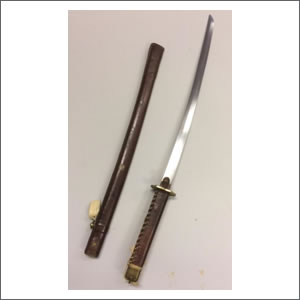 Japanese Katana.
A katana is a Japanese sword characterized by a curved, single-edged blade with a circular or squared guard and long grip to accommodate two hands.
It was used by the samurai of ancient and feudal Japan.
This item was acquired by the 7th Hussars during the Burma campaign in 1942.
 2pdr Armour Piercing Round.
From 1935, the Ordnance QF 2-pounder was the staple Anti-Tank weapon used by the British Army, throughout the Empire.
It only started to be replaced in 1942 as the 6-Pounder became available. The Ordnance 2 Pounder found itself the only AT gun of the British army from 1939 to 1942 at least, when the 6-Pdr was introduced on the front-line.
It saw action for most of the war in many theatres of operations with the Commonwealth armies.
However in North Africa against up-armoured Panzer III and IV it proved useless, with limited success at short range on vulnerable spots, and the situation would come to worsen over time.
It was, however, found adequate in the southern Pacific and eastern Indies against weekly protected Japanese tanks.
Discover the vehicles that the regiment used that were equipped with the 2-pounder gun.
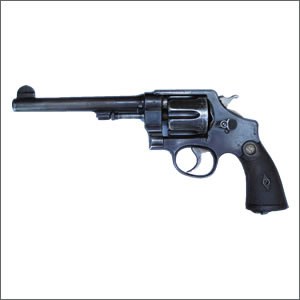 Service Revolver.
This is an example of a Smith and Wesson .38 service revolver.
The .38 S&W is a revolver cartridge developed by Smith & Wesson in 1877. Versions of the cartridge were the standard revolver cartridges of the British military from 1922 until the 1960s.
This type of weapon would of been used by the 3rd Hussars during the Crete campaign, May-Jun 1941.
 Pickelhaube.
When the German army invaded France and Belgium in 1914, its troops wore the 1892 pattern cloth-covered version of the pickelhaube, most often with a regimental number inscribed into or sewn onto the fabric covering.
To Germany’s enemies, the helmet quickly became associated with Hun barbarity as propaganda artists filled British, French and American newspapers with illustrations of pickelhaube-wearing Germans committing all manner of atrocities upon French and Belgian civilians.
As the war entered its second year, leather became scarce in Germany so manufacturers began to produce the helmet using everything from treated felt to sheet metal instead. Even cardboard was used as a substitute.