All timeline stories.

The Battle of Clifton Moor 1745

The Battle of Clifton Moor With a shortage of troops in England, the second Jacobite Rebellion in 1745 called some regiments home, including The King’s Own, who were sent North to fight at Culloden in 1746. The battle at Clifton took place between a rearguard of Prince Charles Edward Stewart’s Jacobite army as they retreated from Derby and elements of the Duke of Cumberland’s Hanoverian forces that were in pursuit. During the action about a hundred government soldiers were wounded…

0
Read More
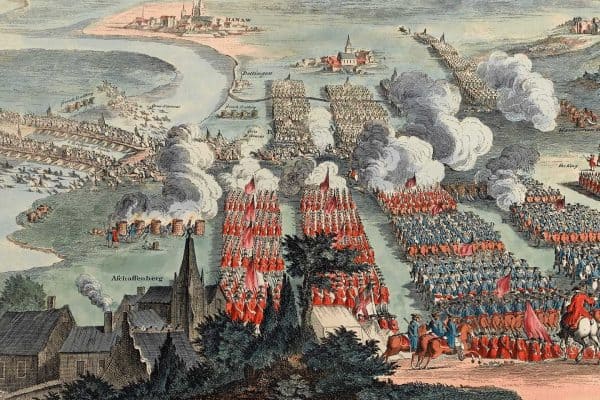
The Battle of Dettingen, 1743

The Battle of Dettingen 1743

The Battle of Dettingen From 1715 until 1742, The King’s Own Regiment of Dragoons soldiered at home, engaging in nothing more exciting than anti-smuggling duty. The uneasy peace in Europe was broken when the Emperor of Austria died and “The War of Austrian Succession” broke out with Britain and Austria once again fighting France. This time there was one major battle and one clear result. King George II was to assume command of his army a week before the battle…

0
Read More
The Battle of Sheriffmuir, 1715

The Battle of Sheriffmuir 1715

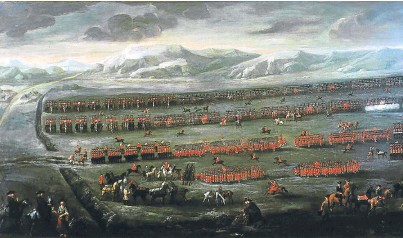
The Battle of Sheriffmuir 1715 When the regiment had finished recruiting in England, it was dispatched north to Scotland. There, it formed part of the English garrison, intimidating the Scottish population in an attempt to repress any attempts at a Jacobite rising. When George I ascended to the English throne in 1714, the regiment’s title was once again altered, and that same year became The King’s Own Regiment of Dragoons. Shortly after his ascension, a major Jacobite uprising occurred; the…

0
Read More

The Battle of Almanza 1707

The Battle of Almanza The Regiment was split in the summer of 1706 when three troops were ordered to join a force of eight thousand commanded by Earl Rivers for a special operation. The other three troops remained at home under Major George Holgate. The Earl of Essex joined the expedition himself and the three troops were his own, Lieutenant-Colonel Dormers and Captain Henry Hawley’s. River’s expedition was planned as a promising combined operation. The force was made up of…

0
Read More
The Battle of Almenar

The Battle of Almanza 1707

The Battle of Almanza In April 1706, the Queen’s Dragoons moved south from Yorkshire to Hampshire in order to conduct some training. Two hundred and forty of them were soon to go into action. The Queen’s Dragoons were led by their new Colonel, Lord George Carpenter, Lieutenant-Colonel Lawrence, ten other officers, four troop quartermasters, a surgeon, a gunsmith and his mate, fifteen N.C.O.s, seven drummers, ten hautboys and 190 privates. They were to join a force of eight thousand commanded…

0
Read More
The Battle of Almenar

The Battle of Almenara 1710

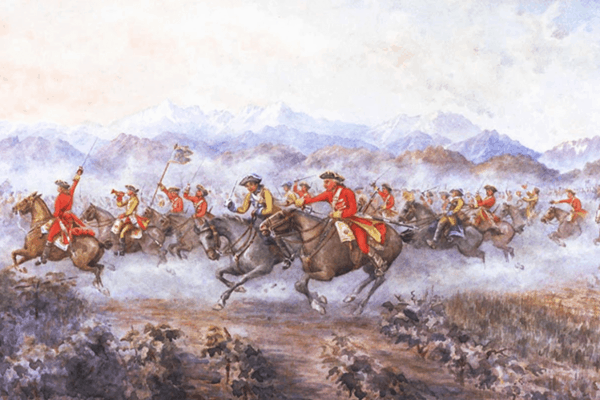
War of Spanish Succession 1701-14 Almenara 27 June 1710 The Regiment, then known as Pepper’s Dragoons, played a vital role in the Allied cavalry’s defeat of the Spanish horse at the Battle of Almenara. Both sides had drawn up their cavalry facing each other with their infantry struggling to catch up and reach the field of battle. Out of twenty-six squadrons of Allied cavalry, sixteen charged across the valley into two lines of Spanish, numbering forty-two squadrons in all, putting…

0
Read More

The Battle of The Boyne

The Battle of The Boyne On 1 July 1690, two armies faced each other across the River Boyne, just to the north of Dublin in Ireland. The commander on the north side was William of Orange, a dutch protestant, who had recently been crowned King of England, Scotland and Ireland. The commander on the south side was James II, the deposed Catholic King, who had lost his throne to William only the year before. The two men were linked by…

0
Read More
The Battle of Steinkirk, 1692

The Nine Year’s War 1688-97

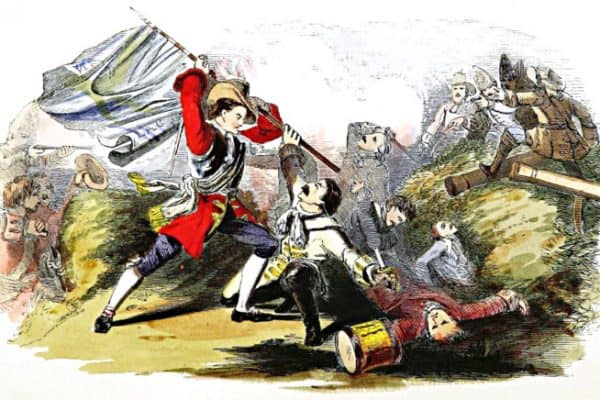
The Battle of Steinkirk 1692 Early in 1692 Fitzhardinge’s Dragoons went to Flanders and fought their first full-scale battle against the French. Fitzhardinge’s crossed to Flanders in the first weeks of 1692, the only Dragoons in the large expeditionary force. The Scottish campaign had only provided skirmishing work, and the regiment had yet to meet well-disciplined troops in full battle. Thus it was that Fitzhardinge rode into battle against the French for the first time in their long history. Riding…

0
Read More

The Glorious Revolution

The Glorious Revolution Also called “The Revolution of 1688” and “The Bloodless Revolution,” took place from 1688-1689 in England. It involved the overthrow of Catholic King James II, who was replaced by his Protestant daughter Mary and her Dutch husband, William of Orange. Motives for the revolution were complex and included both political and religious concerns. The event ultimately changed how England was governed, giving Parliament more power over the monarchy and planting seeds for the beginnings of political democracy.…

0
Read More
8th (The King's Royal Irish) Regiment of Light Dragoons (Hussars) at Chobham, 1853

8th King’s Royal Irish Hussars

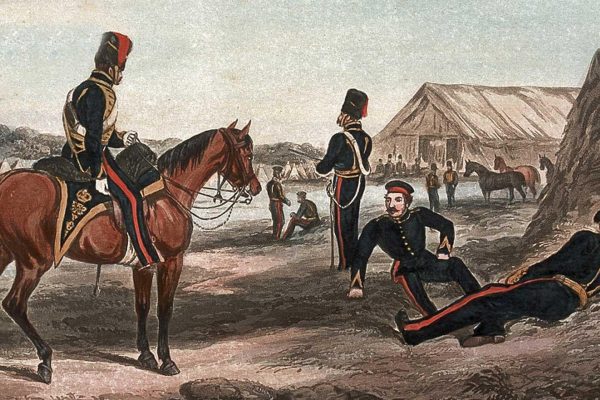
8th King’s Royal Irish Hussars In 1693 Colonel Conyngham, under the authority of The King, raised a regiment of dragoons in Ireland. Early active service of the 8th Hussars, known then as Pepper’s Dragoons,  was during the War of Spanish Succession, at Almenara, where on the 27th of June 1710 they defeated a Spanish Cavalry Corps and to add insult to injury, stole their crossbelts and killed them with their own swords. They were afterwards known as the “Crossbelt Dragoons”,…

0
Read More
Contact Information
QRH Museum
Trinity Mews
Priory Road
Warwick CV34 4NA

Telephone:

01926 506226
SOCIAL MEDIA
LATEST POSTS