Early Years
Originally in the 17th Century the regiments were founded as dragoons or mounted infantry.
The idea was that they rode to the scene of action and then dismounted and fought on foot. in practice it was soon found that they were more effective on horseback and they then evolved into light cavalry or hussars.
Their role was intended to be reconnaissance and scouting but their speed and mobility soon saw them in the thick of the action.
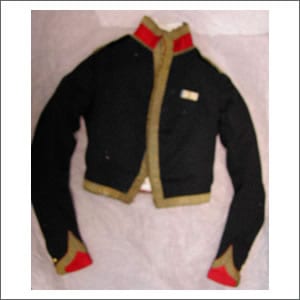 Captain Unett’s Jacket.
A stable jacket (filled blue wool with red piping and gold lace trim), worn at the Battle of Chillianwallah by Captain Walter Unett, 3rd The King’s Own Light Dragoons.
It has a sabre cut to the back and a reputed & famous blood stain.
It has suffered some deterioration.
Discover what the battle of Chillianwallah was like for the 3rd Hussars who took part.
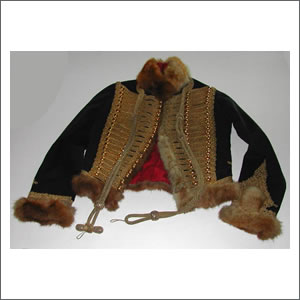 Pelisse.
An Officers pelisse, c. 1840, 7th Hussars.
Repeats the general design of the jacket, except that the collar, front and bottom edges of cuffs are edged with fur.
 Dolmen.
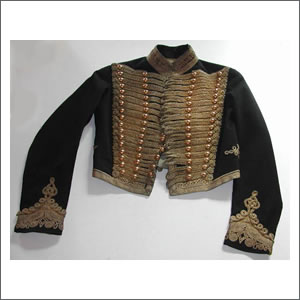
An Officers full-dress jacket, c. 1840, 7th Hussars.
A short single-breasted blue cloth jacket with blue collar and cuffs, it is edged round the collar, cuffs, front and back edge with gold braid formed into loops, circles and diamonds.
 Unett’s Sabretache.
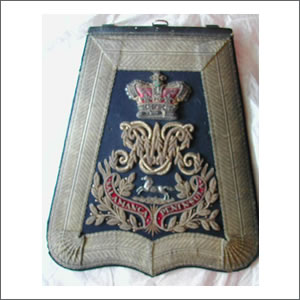
A 3rd Hussars Officers Sabretache, 1830-1837.
The main body of the artifact is comprised of dark blue leather, there is a small brass button for the bag clasp in the centre. The front of the sabretache has a base of filled blue-wool, and is decorated with gold-lace around the rim.
A sabretache is a flat bag or pouch, which was worn suspended from the belt of a cavalry officer together with the sabre.