In 1972 the newly joined Trooper Deakin of ‘B’ Squadron Queen’s Royal Irish Hussars, stationed in Paderborn, was standing by his bed waiting for the barrack room inspection about to be carried out by the Brigade Commander. Trooper Deakin had, during his basic training, become averse to such inspections and when, the Brigadier having detected a north country accent, asked him why he joined the Irish Hussars, he said shortly ‘Because I was effing conned, Sir’. After a short silence the Brigadier asked him whether he was happy. Noticing that RSM Willie Stewart was watching him closely, pace-stick at the ready, Deakin replied ‘Yes Sir.’ ‘Then it was a good con’, said the affable Brigadier, moving on.
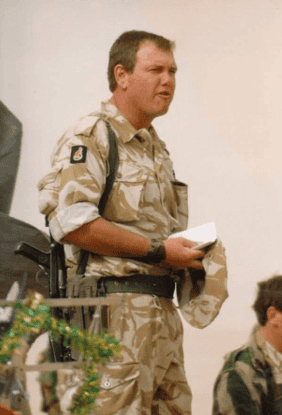
From then on Keith Deakin’s career followed the well-ordered lines of a talented soldier: promotion up the ranks of ‘B’ Squadron to Sergeant and in 1980 a posting to the Driving and Maintenance School at Bovington. This was followed by a spell as a Troop Sergeant and then Troop Leader back in ‘B’ Squadron at Tidworth and Munster. His rise was now unstoppable as he progressed to RQMS in Munster and SSM of Support Squadron in Catterick.
In 1990 he was appointed RSM, playing a major role in the regimental move to Fallingbostel. Another move for the regiment – the most spectacular in the Irish Hussar’s short history – saw RSM Deakin playing his part in preparing his regiment for deployment to Saudi Arabia en route to war. In the desert the QM (Tech) role became unexpectedly vacant and the Commanding Officer took the decision to commission Keith in the field. In this appointment he excelled, and it was no surprise that within a couple of years he was head-hunted to join the Armoured Delivery Squadron at Sennelager.
His return to regimental duty saw him commanding Headquarter Squadron – the pinnacle of his military career. This coincided with the regiment’s deployment to Bosnia-Herzogovina during which he became the officer responsible for (in NATO jargon) G5 matters – that is civil affairs, working with local war-torn communities, providing help and advice, particularly to those citizens who had been ethnically cleansed and were now trickling back home.
Keith Deakin and his senior ranks spent hours listening to refugees’ problems and obtaining help from appropriate agencies, notably the United Nations High Commission for Refugees. In this way after weeks of patient work, streets were cleared of rubbish, houses became inhabited again and over thirty small businesses, schools, colleges and medical centres were resurrected successfully. His outstanding achievements on this deployment were a fitting end to a distinguished regimental career. Two ERE postings completed his service and finally a Retired Officer appointment.
Keith Deakin was the epitome of the best of a family regiment and his work as an Irish and then a Queen’s Royal Hussar left an indelibly positive impression on all ranks, as did his many years contribution to successive regimental rugby teams. To his family go the deepest sympathy of his friends and comrades. He will not be forgotten.