George was killed in action on Friday the 30th of October 1914 (aged 19).
He was the son of James Thomas and Eliza Bradshaw, of 40 South Rd, Wimbledon, London.
Additionally, he is remembered on the YPRES (MENIN GATE) MEMORIAL, Panel 5.
However, he has no known grave.
His name is on the Menin Gate among the 54,000+ British and Empire soldiers.
They were lost in the Ypres Salient before August 1917, and their bodies could not be found or identified.
The town of Gheluvelt was the crisis point of the First Battle of Ypres.
Moreover, the battle is officially recorded as 29–31 October 1914 as part of the wider conflict.
During 29–30 October the Germans launched a huge offensive down the Menin Road to break through to Ypres.
Around Gheluvelt, the British line was held by a thin mix of infantry and dismounted cavalry.
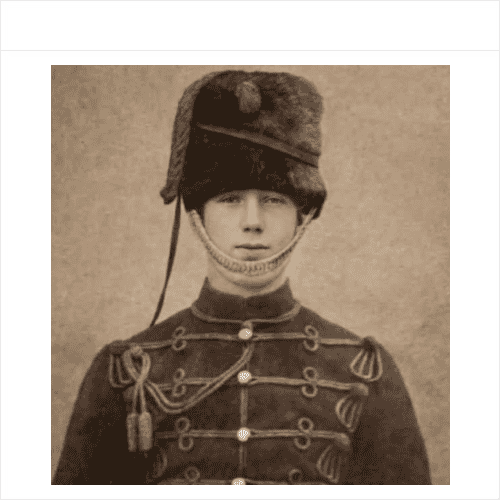
Additionally, this included the 3rd King’s Own Hussars, whose battle honours include Ypres 1914 ’15, Gheluvelt.
On the 30th, the day George was killed, the 3rd Hussars were fighting dismounted in trenches east of Gheluvelt. Under constant shellfire and infantry attacks, they faced heavy fighting throughout the day. Moreover, the next day, the 31st of October, the village was lost. It was then famously retaken by the Worcester’s in a counter-attack that arguably saved Ypres. Many men were lost between the 29th and 30th. They were never recovered from that ground; hence the Menin Gate.
If you ever visit, Panel 5 is on the north side of the memorial, just inside the arch. The Last Post is still sounded there every evening at 8pm.
The year was 1914 when the 3rd (King’s Own) Hussars were stationed at Shorncliffe, Kent.
Britain declared war on Germany on the 4th of August 1914.
At the outbreak of the war, the Regiment was part of the 4th Cavalry Brigade.
The Brigade was in the Cavalry Division that became the 1st Cavalry Division on the 16th of September.
Moreover, on the 14th of October it was transferred to the 2nd Cavalry Division.
The formation the 3rd Hussars served with for the rest of the war on the Western Front.
Shorncliffe was the large cavalry camp above Folkestone.
It left there for France with the British Expeditionary Force on 17 August 1914. It joined the BEF and took part in the Battle of Mons.
George would have been at Shorncliffe with the regiment right up to mobilisation. From there, he crossed to France in August, passing Mons, Le Cateau, the Marne and the Aisne. Finally he reached Ypres and Gheluvelt in October.