OTHER RANKS UNIFORM POST 1881 – HEADDRESS & TUNICS
The style of other ranks busbies closely followed that of officers and the 1858 pattern busby was replaced with the shorter version in 1888.
The last decade of the century saw the Sam Browne system becoming ubiquitous for active service overseas. By the end of the century it was also becoming standard for domestic peace manoeuvres.
For hussars, the first pattern cap (also known as “Torin” or “Austrian” pattern) was also to be dark blue except for the 11th Hussars, whose cap was crimson and the 15th Hussars where it was scarlet. The edges and top were trimmed in gold Russia braid.
Although various editions of dress regulations referred to the lace on forage caps as being of regimental pattern, there was little to determine what that should be. The 1878 regulation states that the lace should match the trouser lace but photographic evidence suggests that it wasn’t so.
The sabretache was a centuries old piece of military equipment. Hungarian and Bavarian hussars carried them in the latter half of the 17th century.
As in other cavalry regiments, the pouch and Pouch-Belt were an important part of the regimental identity of hussar officers. The pouch was originally designed to contain “writing materials” but for the most part was entirely decorative by the 1880s.
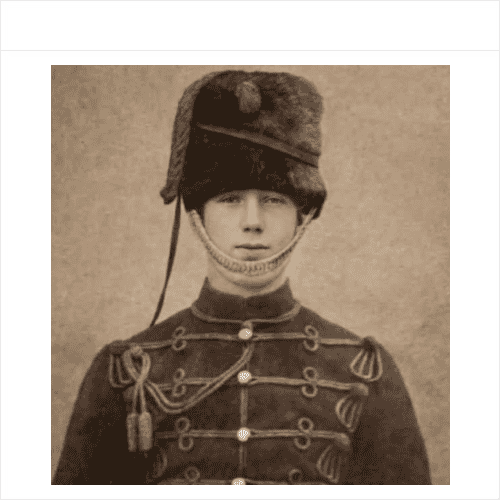
In 1881 hussar officers wore the pattern of busby introduced in 1858. Made of black sable fur, it was 7 ¾ inches high in front, 9 inches at the rear and 8 inches on the sides. The top of the busby to be ½ inch less in diameter than the bottom which was shaped to fit the head.
By 1881 the British hussar tunic was approaching its final form. Inspired by the German and Austrian Attila, the garment introduced in 1856 was long skirted and bore six loops of frogging across the front (Light dragoons had the same tunic but with five loops).
It would naturally take some time for the “Hussar craze” to contaminate the United Kingdom after sweeping over the Continent. The dash of attire and behaviour displayed on the Napoleonic battlefields in the service of France certainly made the best impression, and in due time the British Army started changing her Light Dragoon Regiments into Hussars, in dress and in title. Hussars had appeared in the British army around 1806 and there were four regiments at the end of the…
Major Charles Craufurd Fraser (7th Queen’s Own Hussars) Date of Act of Bravery, 31st December, 1858.