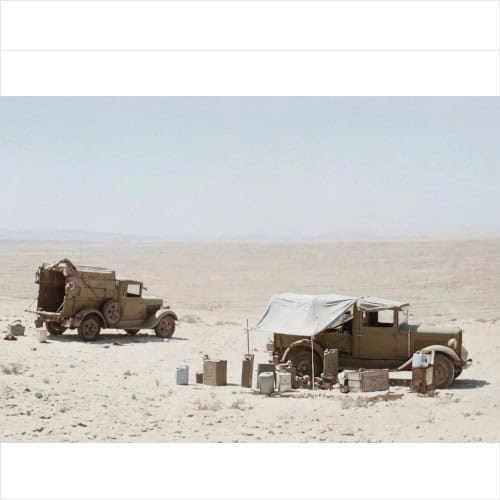
“THERE is no peace for the wicked.” Hardly had most of the Regiment cleaned the dust of the Western Desert of Egypt out of themselves and their cars than the whole Regiment had to take the road for the so-called “land of milk and honey” – Palestine.
We returned to Cairo on 8th April 1936 and left for Palestine on 26th June. Just over two and a half months is not very long to straighten out the details of mechanization, which, owing to the Italian emergency, had been so hurried. However, complaints, if they existed, were hardly audible, not even from those whose leave was stopped by a margin of hours. One officer’s dress-clothes were well on their way by sea to England: he had planned, too optimistically, to follow them by air.
Except for one practice early in June, the parade for the march up to Palestine was the first full regimental parade since mechanization. “B” Squadron, who had not been in the Western Desert, were completed with vehicles only in April, though they had managed to do a good deal of training on odd vehicles lent to them during the winter. All the cars were generally in fair order, as all major repairs had been completed.
Some twenty NCOs and men, with one officer, were left behind to look after the barracks in Cairo, otherwise the whole Regiment departed. Even the “untouchables,” the Band, had to be distributed amongst Squadrons to make up the numbers, and very glad we were to have them once we had settled down in Palestine and they could be spared to make music for us.
Attached to us was a troop of the Royal Corps of Signals with wireless sets, and also a Light Aid Detachment of the Royal Army Ordnance Corps for repair work.
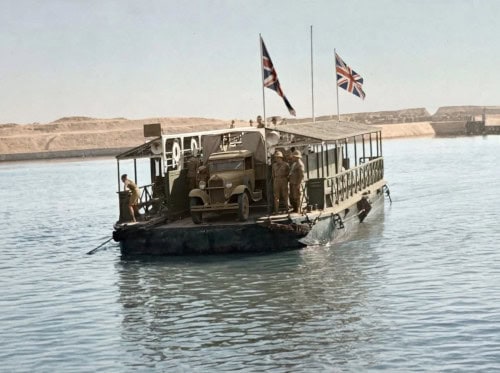
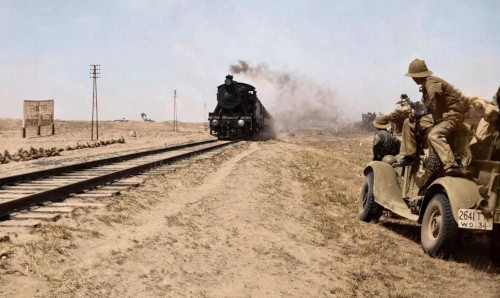
Our heavy stores, spare kits and such like things went up by rail; everything else went by road. We were told we were destined for Jerusalem, a distance by road of some 340 miles. The route was to Kubri Ferry, just north of Suez, where we crossed the Suez Canal, thence across the Sinai Desert, over the Palestine frontier and through Beersheba and Hebron. The track across the Sinai Desert-one can hardly call it a road—is quite passable, and in normal times is frequented by civilian tourist traffic.
As one squadron was ordered to reach Palestine by the evening of 27th June, “B” Squadron was sent on ahead and, after spending the night of the 26th at Hassana, in Sinai, they reached Jerusalem well up to time on the 27th. Unfortunately one car overturned; two of the crew were slightly injured and had to be sent back to Cairo, though the car was driven on to Jerusalem under its own power.
The rest of the Regiment left later on the 26th and spent the first night near the Suez Canal, the second night at Qusaima, near the Egypt-Palestine frontier, and reached Jerusalem during the afternoon of 28th June. There were two accidents en route. One lorry, carrying spare personnel, overturned; by the greatest of good luck no one was seriously hurt.
The other one happened to a back axle, which seized up during the second day’s march; after a marvelous repair by the light aid detachment the car rejoined us at the night’s halt.
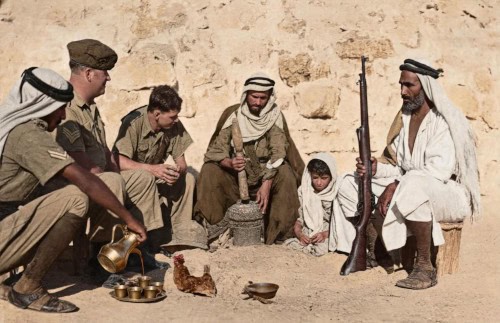
The thought of passing into Palestine was nearly too much for our Mess contractor, a civilian. He had picked up from a native lurid reports of the awful things that were happening there. Had there not been two hundred miles of desert behind him he would certainly have bolted back to Cairo. As it was he had to come on with us.
On reaching the Palestine frontier we were met by a section of armoured cars and an aeroplane to escort us to Jerusalem. We felt a little insulted at this: we were quite capable of getting to Jerusalem without their help. Still we had to swallow the insult and let them escort us. As it turned out we met no opposition at all, though north of Beersheba the road winds through hilly country ideal for ambushes.
Our camp site was a ploughed field on the Southern outskirts of Jerusalem and adjoining the permanent barracks occupied by the Cameron Highlanders. “B” Squadron, who had arrived twenty-four hours before the rest of the Regiment, laid out the camp and pitched a good many of the tents. With the help of a gang of prisoners it did not take long to make the camp reasonably nice, though we were rather crowded. The authorities did all they could to help us, fitted up shower-baths and erected a stout wire fence round the camp—a very necessary precaution.
It must have seemed strange to a good many to see the actual places about which they had read so often in the Bible. A board we passed on the way up, inscribed somewhat as follows, “Bethlehem Municipal Council, Drive Slowly,” made nearly everyone sit up and take notice. We managed to organize a number of sight-seeing trips, including a trip to Jericho and the Jordan; the filling of bottles with Jordan water showed quite plainly who were the expectant fathers.
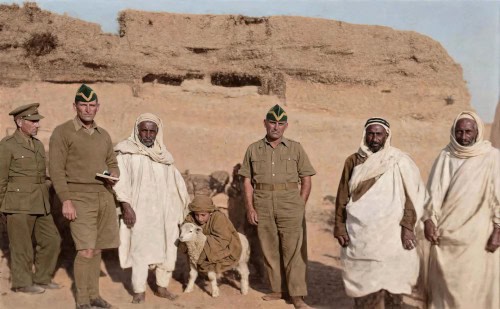
Two days after our arrival in Jerusalem we were warned we would have to take part in a big operation in which all available troops were to make a big drive through the hills north of Jerusalem and endeavour to round up the armed bands. The whole Regiment, therefore, except for a few men left to guard the camp, moved out on the afternoon of 5th July. On the way to our position the advanced guard was shot at by a party of about eight men, but, quickly getting into action, they accounted for at least one of them.
Unfortunately two squadrons took the wrong track and were late getting into position.
In the hurry to get back on the right track a car was overturned and one man seriously injured.
We held a cordon for twenty-four hours and were then told to concentrate and to stay near our old position. Early next morning, after being out two nights, we were told to return to our camp.
We did not much enjoy this operation. There was a certain amount of sniping at us, but few bandits were caught. We were also handicapped by lack of local knowledge, as we had only one civil police corporal with the Regiment, who did not know the area.
After returning to Jerusalem we were given odd jobs to do. Nearly every night the telephone wires leading to Jerusalem from the country were cut. In the morning the Post Office authorities would repair them. It became our job to escort these repair parties and to protect them while at work; only a troop was usually required. We continued to do this for well over two months; in until the arrival of the 1st Division. Another job we were given was to surround a village suspected of being the centre of the arms traffic, while it was being searched. The search yielded nothing of importance and we returned empty handed after making a round trip of some 100 miles.
Another time we had to escort the High Commissioner from Jaffa to Jerusalem, but this was not a great success. His Excellency’s chauffeur drove so fast that the escort could not keep up, and His Excellency reached Jaffa a good many minutes in front of his escort.
Since the beginning of the troubles, no troops had been permanently stationed in the southern part of Palestine, except for a small guard on railway and aerodrome at Gaza.
Both these are important; the railway and the telegraph line is the main line of communication with Egypt; an essential link in the aerial communications to India and the East.
Towards the middle of July it became a nightly occurrence for the telephone wires to be cut and for the railway to be damaged.
The authorities also feared that the tribes or Bedouins-who frequent that part of Palestine were becoming dis-affected.
We were therefore sent down there to try and keep the country quiet.
First ‘A’ Squadron went to Beersheba, and then a few days later Regimental Headquarters and another Squadron were sent to Gaza, where we joined up with a platoon of the Cheshire Regiment and of the Royal Scots Fusiliers who were already guarding the railway station and the aerodrome. The third Squadron had to stay in Jerusalem, where we also left most of the administrative side of Regimental Headquarters, there being no room for them in the camp at Gaza. With the three Squadrons thus distributed we were able to ring the changes and to avoid the monotony of too long a stay in one place.
Each Squadron spent a fortnight at Gaza, or Beersheba, and a week in Jerusalem, when cars were looked over and the Squadron carried out any odd jobs which Force Headquarters might require.
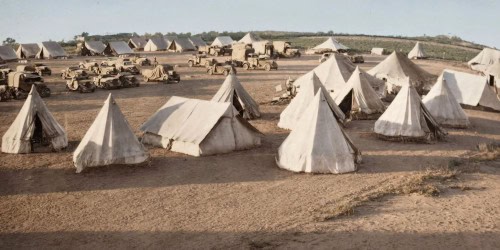
This system of reliefs was continued until early in September. The camp at Gaza which we had to make was next to the Imperial Airways aerodrome. After a few days water was laid on and the camp was passably comfortable. At Beersheba everyone was billeted in the school built by the Turks or Germans before 1914. It made an excellent billet and was not being used, as all the children were on strike. The officers lived in the house of the British Police Officer, to whose very extended hospitality we are much indebted.
Our work at first consisted of constant and irregular patrolling, both by day and night, along the railway and out into the country. Twice a patrol visited the southern end of the Dead Sea, where a potash works was situated quite a pioneering achievement, since, so far as we could discover, no cars had been there before.
We were never molested during the day, but at night there was usually some sniping. Even with the help of a searchlight, which was attached to us, we could not get to grips with the snipers, though once we managed to intercept a party on their way to damage the railway.
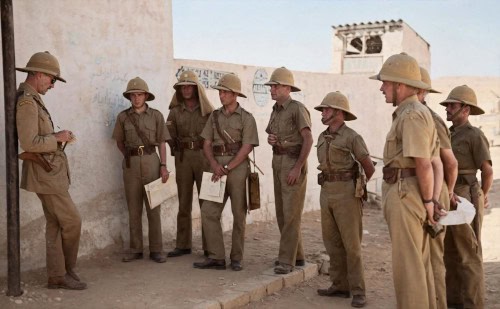
Our chief troubles came from mines buried in the sandy tracks along which we had to patrol. We were lucky to have only one man hurt. Our only retaliation was to demolish the houses of some of those known to be disaffected, not at all a pleasant operation. We never succeeded in finding the actual culprits.
There were few facilities or opportunities for amusement. A cinema was out of the question, as no adequate electric power was available. Bathing was the chief stand-by and every day most people went down for a bathe in the sea. But even this had its drawbacks; the coast was very dangerous. especially when the sea was rough; it was unsafe to go in much more than waist deep.
The Band came down from Jerusalem a few times and gave those at Gaza a concert, which was much appreciated, and when the weather became cooler. hockey and football were started and we had some good contests against the Royal Air Force Squadron stationed at Gaza aerodrome. Nor were many more amusements to be had in Jerusalem. The seven o’clock curfew for all civilians prevented any evening amusements and all cinemas were closed. The swimming bath at the Y.M.C.A., of which we managed to get exclusive use for an hour on several days a week, was much appreciated.
Luckily about the middle of August we were allowed to send parties on leave to Cairo. Those who were married went first. In this way a large number of men had a good week’s change, as we were able to continue these leave parties right up to the time of leaving Palestine.
The officers managed to pass the time away by some sand-grouse shooting and an odd chukker of polo on Gaza aerodrome with the Police, on ponies provided by them. Visits to the old battlefields and to many places of archaeological interest in the neighbourhood were also generally appreciated. Life was at times inclined to become rather monotonous, but the monotony usually did not last for very long. A mine under a car or sabotage on the railway line and elsewhere soon put everyone on their toes again.
Early in September, owing to a deterioration of the situation in the north, “C” Squadron was sent up to protect a Jewish colony at Hadera, a few miles south of Haifa. This meant that they had to be replaced in Jerusalem by “A” Squadron from Gaza, leaving only “B” Squadron in the south. We had, therefore, to leave Beersheba, even though we were reinforced by four armoured cars, because protection of the railway and telegraph was our primary job. Thus the Regiment became very scattered, each Squadron being separated by some sixty miles, though “A” and “B” Squadrons changed places during the middle of September.
“C” Squadron quite enjoyed their stay of about three weeks in the north. They found some good billets and the inhabitants generally were quite helpful; and last, but by no means least, there was a cinema which produced on occasions quite tolerable films. Fresh food was more easily obtainable, and it was noticeable, particularly in the case of one or two officers, that figures had responded well to a daily ration of cream.
Towards the end of September the 1st Division from home started to arrive, which of course meant a redistribution of the units already in the country. “B” and “A” Squadrons returned to the Regiment from Jerusalem and Hadera respectively, and all our stores were moved down to Gaza.
Just before leaving, two troops of “B” Squadron took part in a night operation between Jerusalem and Hebron, in which they most successfully cleared two road blocks, dispersed the Arab bandits who were covering the blocks, and opened up the road.
After the concentration of the whole Regiment our task remained much the same. We were still to be responsible for the whole of the southern part of Palestine but were also given an additional area to the north to look after, which contained some Jewish colonies. But, whereas before we had only one Squadron for the job, we now had three.
“A” Squadron went some twenty miles north of Gaza to Majdal, with two troops still farther north amongst the Jewish colonies, while “C” Squadron, with all of Regimental Headquarters, stayed at Gaza. “B” Squadron reoccupied Beersheba. These moves were completed by the end of September.
On 12th October the Arabs decided to stop all outrages and to call off the strike. Up till then the situation in our part of the world had remained more or less the same-intermittent damage to the railway and telegraph lines. mines on the roads, bombs mostly harmless and sniping at night. But after the 12th all these stopped and we reverted-or tried to, our normal peace-time habits, by no means an easy task in that part of the world, where the usual amenities of life were practically non-existent.
The Band was a great stand-by; Inter-Squadron and Inter-Troop football provided some interest, and we tried to do a little mild training, though peace-time exercises came rather as an anticlimax after a taste of the real thing. All sorts of rumours about our early return to Cairo reached us and we did what we could to foster that idea, as life was rather monotonous for everyone. But for a time nothing definite materialised and we had to make arrangements for staying on through the cold weather.
Anytime at or after the end of October rain is to be expected, as well as a possibility of quite cold weather. And reports said that the rain, when it did come, would be no mere shower. Though it may not last long it is often severe enough to turn the country into a quagmire for several days at a time, and our camp at Gaza, which was an old ploughed field, would have become impossible. We had to do our best to find billets.
Luckily there were some quite good schools to be had, which we occupied, though we were rather crowded and much too close to the very smelly native dwellings. The Government Girls’ School accommodated the officers; the girls were on strike and elected to remain so until we had finished with their school. Two troops of “A” Squadron who were in the north of our area, and also under canvas, came back into billets at Gaza. The remainder of the Regiment who were at Beersheba and at Majdal were already in houses.
From further inquiries at Divisional Headquarters in Jerusalem, as to our return to Cairo, we seemed likely to have to stay in Palestine for at least another month. Squadrons were therefore changed round-much to the annoyance of “B” Squadron at Beersheba, who had the best billets. “A” Squadron replaced “C” Squadron at Gaza, “C” replaced “B” at Beersheba, and “B” took over “A” Squadron billets, half in Majdal and half in Gaza. Of course two days after these moves were completed we were told we could return to Cairo as soon as we could pack up.
Packing up was not as easy as it sounds. We had all our tents and a considerable amount of camp equipment to take back to Cairo, a good deal of which had to be fetched in from out-stations. Then in Cairo the 12th Lancers were in our barracks, and somehow we had to be squeezed in with them. All this taxed the Quartermaster and his staff to the utmost. But, ably assisted by many fatigue parties, they rose nobly to the occasion, and on 12th November “B” and “C” Squadrons left for Cairo, to be followed on the 14th by “R.H.Q” and “A” Squadron. Both parties spent one night on the way and had a good and uneventful march back. A small rear party stayed behind to hand over billets and returned by train.
For a fortnight we shared our barracks with the 12th Lancers, after which they embarked for home. We cannot be too grateful to them for the help they gave us and for the trouble they took to avoid any friction which might so easily have occurred. They would have been quite justified in saying that it was impossible to put both Regiments into one barracks, which would have meant for us a stay of another fortnight in Palestine. By then, as it happened, it had started to rain, making roads impassable, and our return would have been still further postponed.
To consider Palestine in retrospect: I think we all enjoyed a large part of our stay there. Though at times monotonous, our life was considerably more interesting than normal peace routine throughout the summer in Egypt. We also had just a taste of real war, and there are not many people left in the Regiment who have had that.
As to whether we did our job well or otherwise, one cannot do better than quote the opinion of those in authority. The Corps Commander, General Dill, at a farewell parade, said ” If I find I want more troops back in Palestine, you will be one of the first Regiments I shall ask for “— a compliment that at the time we felt might almost have been dispensed with — and the following order was published at the request of the First Divisional Commander, under whose command we were :- “On the departure of the Regiment from Palestine, I should like to convey to you and to all ranks under your command my appreciation of the work of your Unit in this country. It is thanks to the energy and efficiency of your Regiment that the Gaza-Beersheba area has remained comparatively quiet during the troubles. The cheerful spirit in which your Officers and men have carried on in conditions of great discomfort has been an example to all Units.”
Evidently we did not do too badly!
By Lt Col F Thornton
VIII King’s Royal Irish Hussars