If your enemy is hungry, feed him, and if he is thirsty, give him a drink; for in so doing you will heap burning coals on his head.” Do not be overcome by evil, but overcome evil with good.
Romans 12:14-21
You don’t worry too much about the ones screaming with pain, as they’re not in imminent danger of dying. It’s the ones who’ve gone quiet you have to look at first.
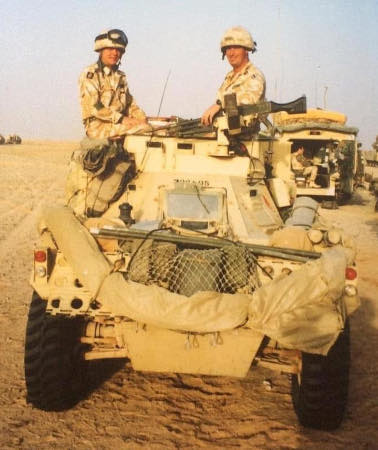
As I was moving forward towards a group of about 14 surrendering Iraqi soldiers, my driver became very unsettled by all the dead bodies lying around the position. he said, “Please sir, don’t make me touch a dead body,” and explained it was the first time he’d seen one since his father died. I replied, “Don’t worry, I’ll do that.”
I went through the position and tried to stir the ones that weren’t showing any movement, to make sure they were dead. Some were starting to decay, a stench that will stay with me as long as I live. There were eleven injured so I asked RHQ to send ambulances.
We searched the injured to make sure they couldn’t give us any harm, but when we picked one up who couldn’t help himself, his body literally fell apart in our hands. I thought they’d been ripped up by machine gun fire, although it could have been artillery airburst.
It looked like these poor sods had either been put into an open position they couldn’t get out of without armoured cover, or if there had been tanks, they had deserted them.
Many of these positions were surrounded by mines, so the Iraqis in the trenches couldn’t actually get out. An anti personnel mine exploded under one of the ambulances, and an 18 year old ambulance crewman showed great courage and common sense, which I later reported to his Squadron Leader.
Our Ambulance Crews and Admin Troops were backfilled up with our new arrivals with young Troopers averaging the age of 18 and one was even 17 years of age.
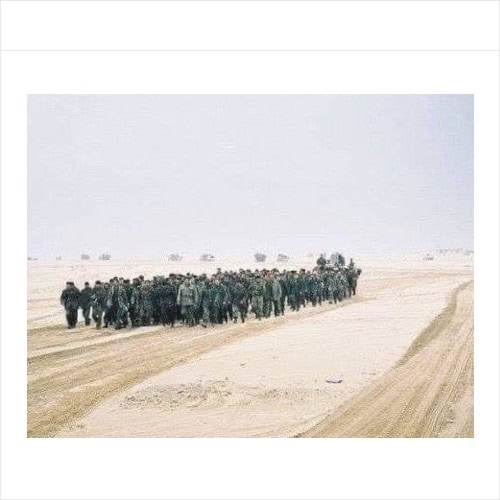
On our way back to the front line, another file of prisoners walked towards us, flying white hankies on sticks. Their leader spoke excellent English with an upper crust accent, a doctor, the Major commanding an Iraqi Medical unit.
They had no weapons but we search them, gave them water and oatmeal blocks, then drove the 2 km back to A1 echelon with them siting on the back of the Ferrets.
They had no weapons and were wearing flipflops and some only T-shirts. The Doctor told me he thought we were going to shoot them. I assured him we were not barbarians.
This intelligent medical gentleman had been abandoned by their supposedly elite Republican Guard. One of his soldiers was only 15, the same age as my daughter, the others were much older than anyone in our Regiment. I felt utmost sympathy for them, and how lucky we were that our officers would always stay with us, regardless what happened.
We got the Iraqi Doctor and prisoners back, where I explained that they were medics prepared to help the injured people we had already got; that they were hungry and needed food, had been thoroughly searched, had behaved impeccably, and were no threat.
We hadn’t eaten so, I got a tin of warm beans out of my boiling vessel, some very stale bread and made Des and myself a sandwich.
As we were about to head off, I heard shouting; obscenities hurled at these prisoners. I’ve since thought very deeply about this incident. I’d very carefully briefed this officer about this group of prisoners and their English speaking Major and I was the Regimental Sergeant Major of the Irish Hussars which should count for something. I went back and remonstrated with him, advising him that if he didn’t treat the prisoners correctly, I would report it.
We then had to leave for the front line, but I did take a degree of relief from knowing that the prisoners would not remain long with echelon. Later I reported the incident to the Commanding Officer.
WO1 RSM Johnny Muir, QRIH