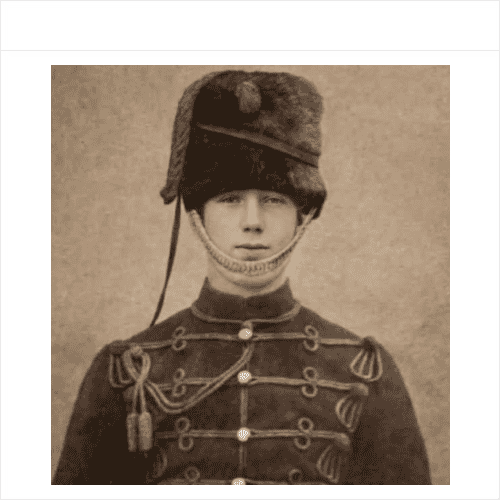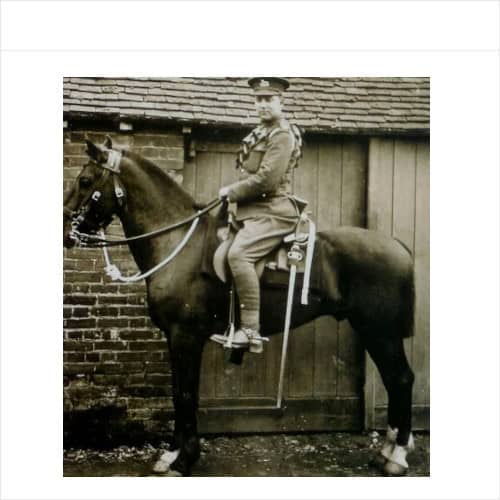
Arthur Wilson enlisted in the Army at Shorncliffe, Kent, and initially served in the 3rd (Kings Own) Hussars before being transferred to the 8th King’s Royal Irish Hussars.
The following extract is from the diary of Lieutenant George Anthony Alkinson-Willes, the Adjutant of the 8th (King’s Royal Irish) Hussars, and the official war diary of the 8th Hussars.
Through these documents we have a vivid picture of the battle in which Arthur Wilson lost his life, on Friday the 30th of November 1917, aged just 24.
For Friday 30 November, the 8th (King’s Royal Irish) Hussars War Diary states that it was a fine day. At 9.30 am, orders were received by the Regiment to move immediately in a Northerly direction. Saddles and weapons had to be packed and a dump made. The Regiment paraded and reached the Brigade starting point by 11 am.
The Brigade then trotted to Villers Faucon which was probably via Hancourt and Roisel as the War Diary does not say. It does, however, say that when they reached Villers Faucon, a rest of 30 minutes was taken before moving off again at 1.30 pm, having been given fresh orders to clear up the situation towards Gauche Wood.
With ‘C’ Squadron as the advance guard, the Hussars moved through the North West edge of Épehy. At the point where they passed Épehy, they were subjected to heavy machine gun fire from a position in a sunken road near Chapel Crossing and the Regiment was brought to an unwelcome and sudden stop.
Just after the Squadron was stopped by the heavy machine gun fire, the first of the Hussars casualties of the day was recorded; that of Lieutenant T. C. Watson of ‘A’ Squadron, wounded by enemy machine gun bullets.
The Commanding Officer then ordered Major, The Honourable Robert Nathaniel Dudley Ryder to take ‘A’ Squadron on to Gauche Wood. On cresting the skyline, ‘A’ Squadron came under heavy shell fire and were also swept by machine gun fire from the direction of a position at Chapel Crossing as well as from the wood.
Major Ryder’s Squadron quickly manoeuvred their horses and made for a sunken road approximately 1,000 yards West of the wood, from the road, patrols were sent out on Gauche Wood. Soon the patrols were subjected to heavy machine gun fire yet again, and 34 year old Major Ryder was killed and 16 other ranks either killed or wounded.
When Second Boer War veteran Major Ryder was killed, command of ‘A’ Squadron fell to Lieutenant Staniland who, with 15 men, held the sunken road position. On the right of him and his party were Indian Lancers of 9th Hodson’s Horse who were also part of the Ambala Cavalry Brigade having been stationed there prior to hostilities.
At approximately 3 pm, the German’s launched a heavy counter-attack from where they had been concealed in Gauche Wood. When their attack began, it soon became clear to the Lieutenant and his Hussar/Lancer force he then commanded, that the enemy was far greater in strength at the Gauche Wood positions than had been envisaged.
British and Indian Cavalrymen fighting as Infantrymen certainly gave a good account of themselves when waves of enemy infantry tried to press home their attack. As time went by it became noticeable how one-sided the casualties were.
Although vastly numerically superior, the losses were also far larger amongst the Germans. The longer the fighting continued, the heavier enemy losses became, to such an extent that to the relief (and probable surprise of the dismounted Cavalrymen), the enemy attack was abandoned at the sunken road.
During the action fought by the 8th (King’s Royal Irish) Hussars on Friday 30 November 1917, a German counter-attack was successfully thwarted, and the regiment succeeded in capturing two Maxim machine guns, similar to the two which were captured in the same area in March 1917 which are now on display outside Regimental Headquarters of the Queen’s Royal Hussars.